
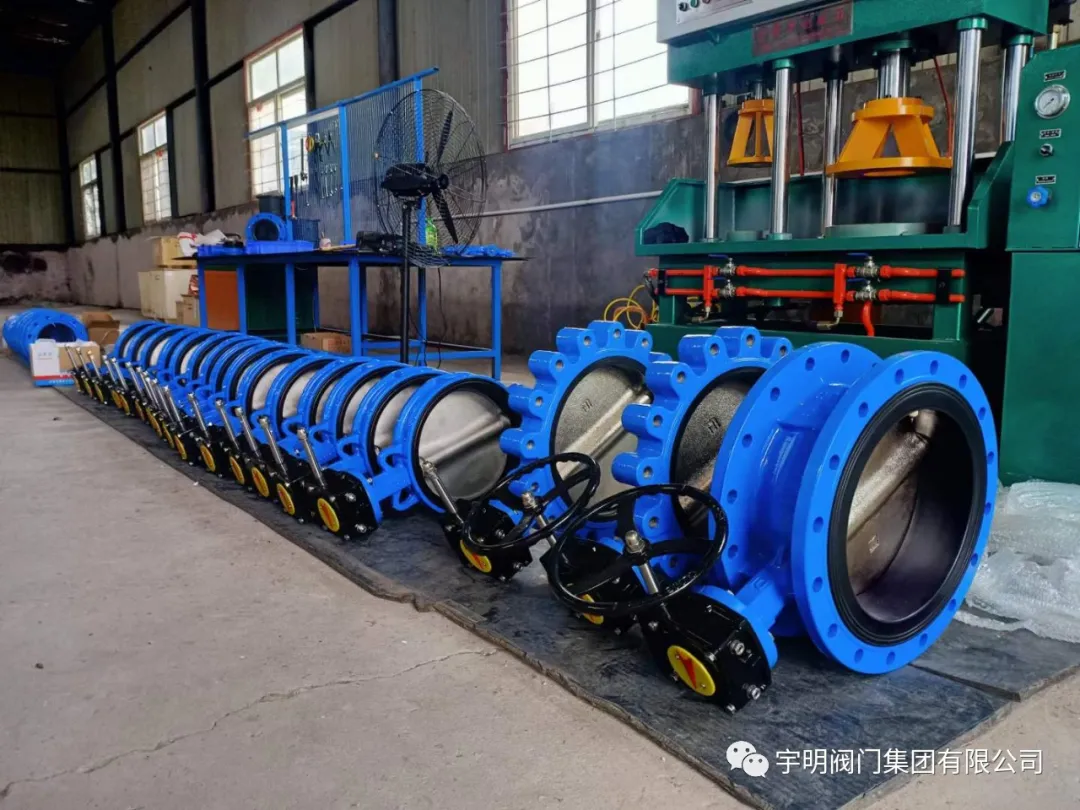

Butterfly valves are simple in structure, compact, lightweight, and consist of only a few components. They can be quickly opened or closed by rotating 90°, offering easy operation and excellent flow control characteristics. The sealing principle and structural features of flanged butterfly valves are similar to standard concentric butterfly valves.
The sealing structure of flanged butterfly valves utilizes a composite valve seat made of PTFE (Polytetrafluoroethylene), synthetic rubber, and phenolic resin, which enhances both elasticity and strength. The butterfly disc is fully encapsulated in PTFE, providing strong corrosion resistance.
Flanged butterfly valves are primarily used in water supply, drainage, and gas pipelines to regulate flow and isolate media. They can be quickly closed with a 90° rotation, ensuring ease of use and superior flow control.

Key Features of Flanged Butterfly Valves:
1.Compact and Lightweight: Easy to install, disassemble, and maintain, suitable for installation in any position.
2.Simple and Robust Structure: Compact design with low operating torque and quick 90° rotation for opening and closing.
3.Linear Flow Characteristics: Excellent flow regulation performance.
4.Pinless Connection: The disc and valve stem are connected without pins, eliminating potential internal leakage points.
5.Improved Sealing: The disc adopts a spherical design, enhancing sealing performance and prolonging valve lifespan, with zero leakage even after over 50,000 pressure-assisted operations.
6.Replaceable Seals: Reliable, dual-directional sealing with easily replaceable sealing components.
7.Custom Coating Options: The disc can be coated with materials such as nylon or PTFE upon request.
8.Versatile Connection Designs: Available in both flanged and wafer-style connections.
9.Multiple Actuation Options: Can be operated manually, electrically, or pneumatically.
Flanged butterfly valves are suitable for temperatures ≤120°C or ≤150°C and nominal pressures ≤1.6 MPa. They are widely used in water supply, wastewater, food processing, heating, gas, marine, hydropower, metallurgy, energy systems, and textile industries. These valves are particularly ideal for applications requiring dual-directional sealing or where valve bodies are prone to corrosion. They are used to regulate flow and isolate media effectively.

相关文章

"Fifty Years of Excellence, Creating a Brighter Future Together": Yuming Valve Group's 50th Anniversary Celebration and 2024 Annual Sales Review Conclude Successfully

[New Year's Day] A New Year Dawns, Blessings Begin

2024 International Conference on Nuclear and Radiation Safety Highlights Advances in Nuclear Power Valve Technology

Secrets to Valve Sealing Surface Restoration: Grinding Techniques and Abrasive Selection


Friendly Links


Subscribe to our mailing list

