
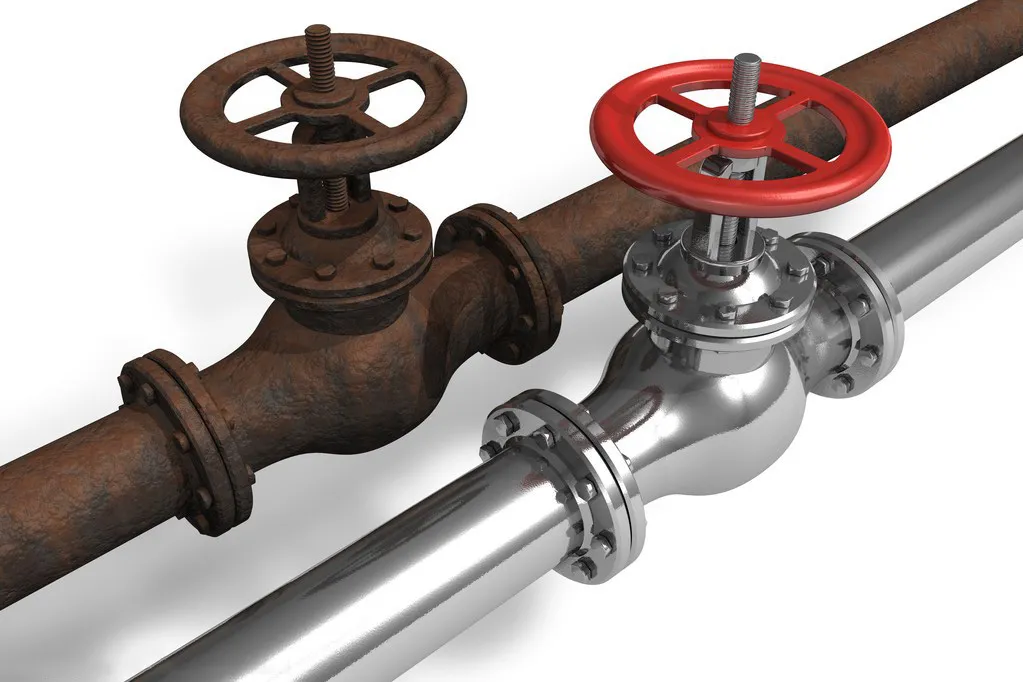


Electrochemical Corrosion
Electrochemical corrosion occurs when two dissimilar metals are in contact and exposed to a corrosive liquid or electrolyte, forming a galvanic cell. The resulting current increases the corrosion rate of the anodic material. This corrosion typically occurs near the contact points. Corrosion can be mitigated by electroplating dissimilar metals to create a more uniform surface.
High-Temperature Corrosion
To predict the effects of high-temperature oxidation, the following factors must be analyzed:
1.Metal composition
2.Atmospheric composition
3.Temperature
4.Exposure duration
It is well-known that most light metals, whose oxides are lighter than the base metal, form non-protective oxide layers that thicken and eventually flake off over time. Other forms of high-temperature corrosion include sulfidation, carburization, and others.

Crevice Corrosion
Crevice corrosion occurs in areas where oxygen diffusion is restricted, creating high and low oxygen concentration zones. This leads to a concentration cell effect. Narrow crevices, particularly around fasteners or weld defects, can trap electrolyte solutions, forming a galvanic cell between the metal inside and outside the crevice. Severe localized corrosion often results within the crevice.
Pitting Corrosion
Pitting corrosion arises when a protective film is disrupted or a corrosion product layer breaks down, leading to localized damage. The damaged areas act as anodes, while the intact film or corrosion product serves as the cathode, forming a closed circuit. In the presence of chloride ions, stainless steels are particularly prone to pitting. Pitting often occurs in surface irregularities due to their non-uniformity.

Intergranular Corrosion
Intergranular corrosion occurs along the grain boundaries of metals and can significantly weaken the material's mechanical properties. This typically happens in austenitic stainless steels exposed to temperatures between 800°F and 1500°F (427°C to 816°C) without proper heat treatment. Susceptibility to certain corrosive agents can cause intergranular attack. This type of corrosion can be prevented by solution annealing at 2000°F (1093°C), using low-carbon stainless steel (C ≤ 0.03%), or employing stabilized grades containing niobium or titanium.
Fretting Corrosion
Fretting corrosion results from mechanical wear that breaks the protective film and exposes the base metal to corrosion. The severity depends on the force and velocity of movement. Excessive vibration or bending of metal can lead to similar effects. Cavitation is a common form of corrosion in pumps.

Stress can lead to corrosion cracking and cyclic loading can lead to fatigue corrosion. Fatigue corrosion occurs when the fatigue limit is exceeded under non-corrosive conditions. Surprisingly, both types of corrosion are more harmful when they exist together. This is why it is important to use the best possible corrosion protection under alternating stresses.
相关文章

"Fifty Years of Excellence, Creating a Brighter Future Together": Yuming Valve Group's 50th Anniversary Celebration and 2024 Annual Sales Review Conclude Successfully

[New Year's Day] A New Year Dawns, Blessings Begin

2024 International Conference on Nuclear and Radiation Safety Highlights Advances in Nuclear Power Valve Technology

Secrets to Valve Sealing Surface Restoration: Grinding Techniques and Abrasive Selection


Friendly Links


Subscribe to our mailing list

