
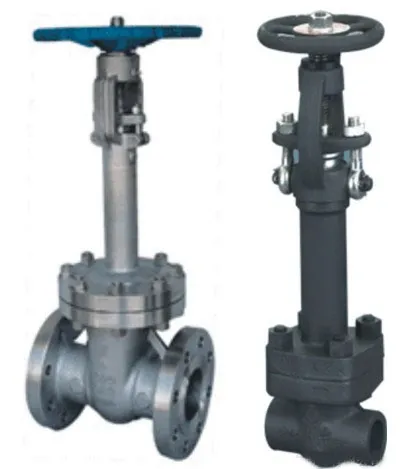

In recent years, with the development of industries such as petrochemicals, air separation, and natural gas, the use of cryogenic valves has become increasingly widespread. Cryogenic valves refer to valves used for mediums at temperatures ranging from -40℃ to -196℃. Common types of cryogenic valves include cryogenic butterfly valves, gate valves, ball valves, globe valves, check valves, and throttling valves. These valves are essential in many industries, and their quality directly determines whether safe, economical, and continuous production can be achieved. With advancements in modern technology, cryogenic valves are being used more extensively, and their demand is steadily rising.
For cryogenic gate valves (-100℃ to -30℃), the main materials used are low-temperature austenitic stainless steel and low-temperature pressure-bearing ferritic and martensitic steels.

Key Features of Cryogenic Gate Valves
1.Lightweight Design: The valve body is made of high-grade ductile iron, reducing its weight by approximately 20% to 30% compared to traditional gate valves, making installation and maintenance easier.
2.Flat-Bottom Seat: Traditional gate valves often accumulate debris like stones, wood, cement, or iron filings in the groove at the bottom after pipeline flushing, leading to leakage. Cryogenic gate valves use an elastic valve seat seal with a flat-bottom design, similar to that of water pipes, preventing debris buildup and ensuring smooth fluid flow.
3.Fully Encapsulated Gate: The gate is entirely encapsulated with high-quality rubber. European-grade rubber vulcanization technology ensures accurate geometric dimensions and strong adhesion between the rubber and the resilient cast gate, preventing detachment and providing excellent elastic memory.
4.Minimal Flow Obstruction: Cryogenic gate valves offer low fluid resistance, and the sealing surfaces experience minimal abrasion and corrosion from the medium.
5.Precision Cast Body: The valve body is precision-cast, achieving accurate geometric dimensions. This eliminates the need for additional machining on the interior, ensuring excellent sealing performance.

相关文章

"Fifty Years of Excellence, Creating a Brighter Future Together": Yuming Valve Group's 50th Anniversary Celebration and 2024 Annual Sales Review Conclude Successfully

[New Year's Day] A New Year Dawns, Blessings Begin

2024 International Conference on Nuclear and Radiation Safety Highlights Advances in Nuclear Power Valve Technology

Secrets to Valve Sealing Surface Restoration: Grinding Techniques and Abrasive Selection


Friendly Links


Subscribe to our mailing list

