
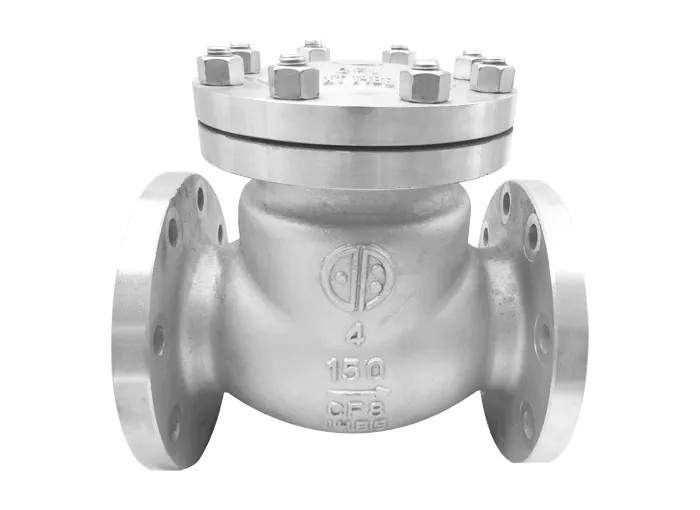

Working Principles of Check Valves:
Check valves are used in pipeline systems to prevent reverse flow, protect pumps and their driving motors from reverse rotation, and prevent discharge of the medium from containers. They can also supply auxiliary systems where pressure may exceed that of the main system. Depending on the material, check valves can be used with various pipeline mediums. Once installed, the check valve becomes an integral part of the pipeline system, with its opening and closing processes influenced by transient flow conditions. Conversely, the valve disc's closing characteristics also affect the flow state of the fluid.
Types of Check Valves:
Swing Check Valve:
The disc of a swing check valve is disc-shaped and rotates around a pivot axis within the valve seat. The streamlined design reduces flow resistance compared to lift check valves, making it suitable for low flow rates and large-diameter applications with minimal flow fluctuations. However, it is not recommended for pulsating flow, and its sealing performance is inferior to that of lift check valves. Swing check valves are categorized into single-disc, double-disc, and multi-disc types, primarily based on valve size, to reduce hydraulic impact when the medium stops or reverses flow.

Lift Check Valve:
In lift check valves, the disc slides along the vertical centerline of the valve body. These valves can only be installed in horizontal pipelines. For high-pressure, small-diameter applications, the disc may be designed as a sphere. The valve body resembles that of a globe valve (often interchangeable), resulting in higher flow resistance. Its structure is similar to a globe valve, with a similar body and disc design.

Silent Check Valve:
The disc is guided by sleeves on both the upper side of the disc and the lower side of the valve cover, allowing free vertical movement. When the medium flows, the disc opens under the medium's force; when the flow stops, the disc drops onto the seat by gravity, preventing reverse flow. Straight-through lift check valves have medium inlet and outlet directions perpendicular to the seat, whereas vertical lift check valves have inlet and outlet directions aligned with the seat, offering less flow resistance than straight-through designs.

Butterfly Check Valve:
This type features a disc that rotates around a pivot within the valve seat. Butterfly check valves have a simple structure but can only be installed in horizontal pipelines and have relatively poor sealing performance.

Pipeline Check Valve:
The disc slides along the centerline of the valve body. This newly developed valve type is compact, lightweight, and offers excellent manufacturability, making it a promising direction for check valve development. However, its flow resistance is slightly higher than that of swing check valves.
Pressure-Seal Check Valve:
These valves serve as boiler feedwater and steam cut-off valves, combining the features of lift check valves and globe or angle valves.
Additional check valves unsuitable for pump outlet installations include foot valves, spring-loaded check valves, and Y-pattern check valves.

Installation Guidelines for Check Valves:
1.The check valve should not bear the weight of the pipeline system. Large check valves should be independently supported to avoid stress from pipeline pressure.
2.Ensure the flow direction of the medium matches the arrow marked on the valve body during installation.
3.Vertical lift check valves must be installed in vertical pipelines.
4.Horizontal lift check valves should be installed in horizontal pipelines.
相关文章

"Fifty Years of Excellence, Creating a Brighter Future Together": Yuming Valve Group's 50th Anniversary Celebration and 2024 Annual Sales Review Conclude Successfully

[New Year's Day] A New Year Dawns, Blessings Begin

2024 International Conference on Nuclear and Radiation Safety Highlights Advances in Nuclear Power Valve Technology

Secrets to Valve Sealing Surface Restoration: Grinding Techniques and Abrasive Selection


Friendly Links


Subscribe to our mailing list

