
行业新闻
Yuming Valve Knowledge Hub | Can Globe Valves and Gate Valves Be Used Interchangeably?
2023.11.08
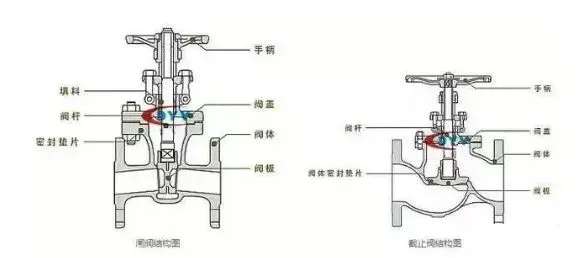
Globe valves, gate valves, butterfly valves, check valves, ball valves, and other types of valves are indispensable control components in modern piping systems. Despite their unique appearances, structures, and functions, the globe valve and gate valve are often confused due to their somewhat similar looks and shared ability to control flow. However, a closer examination reveals significant differences between the two.
Structural Differences
Space considerations during installation:
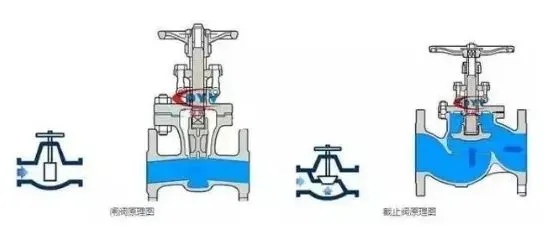
Gate valves rely on the medium's pressure to tightly seal against the seat, achieving a leak-proof effect. During opening and closing, the disc and seat are in constant contact, which results in wear on the sealing surfaces. The wear intensifies when the valve is nearly closed due to a significant pressure differential across the pipeline.
Structurally, gate valves are more complex than globe valves. For the same nominal diameter, gate valves are taller, while globe valves are longer. Additionally, gate valves can have rising or non-rising stems, whereas globe valves do not.

Operating Principles
When opening or closing, globe valves feature a rising stem mechanism, meaning the handwheel rotates along with the stem as it moves up or down. Gate valves, on the other hand, have a fixed-position handwheel, with only the stem moving up and down during operation.
Flow characteristics differ:
Gate valves must be fully opened or fully closed, whereas globe valves do not require this.
Globe valves have a designated flow direction, typically marked by an arrow on the valve body, while gate valves do not require a specific installation direction.
Gate valves offer only on/off functionality, with a long travel distance for the disc, resulting in longer operation times. Conversely, globe valves have shorter disc travel and can regulate flow by stopping at intermediate positions.

Performance Differences
Globe valves serve dual purposes: flow regulation and shut-off. They have higher fluid resistance and require more effort to operate. However, the short distance between the disc and the seat leads to shorter operation times.
Gate valves, being limited to fully open or closed positions, have minimal flow resistance when fully open. This makes them easier to operate, but their long disc travel results in extended operation times.

Installation and Flow Direction
Gate valves can be installed without concern for flow direction, as the medium flows freely in both directions. Globe valves, however, must follow the flow direction indicated on the valve body. In China, the standard regulation dictates that the medium in globe valves flows from top to bottom.
Key points:
Globe valves are designed for "low in, high out" installation, which often results in pipes appearing misaligned when viewed externally. Gate valves, in contrast, maintain a horizontal flow path.
In terms of flow resistance, gate valves have low resistance when fully open, while globe valves exhibit higher resistance.
The flow resistance coefficient of standard gate valves ranges from 0.08 to 0.12, making them easier to operate, with bidirectional flow capability. Globe valves, on the other hand, exhibit 3-5 times the resistance of gate valves and require forced closure to achieve a seal.
Installation Methods
For globe valves, two installation methods exist depending on the direction of the medium:
Bottom-entry flow:
Advantages: When the valve is closed, the packing remains unaffected by pressure, extending its lifespan. The packing can also be replaced while the upstream piping is pressurized.
Disadvantages: Higher operating torque, approximately twice that of top-entry flow, increasing the axial force on the stem, which may lead to bending.
This method is typically used for small-diameter globe valves (DN50 and below).
Top-entry flow:
Advantages and disadvantages: Opposite to the bottom-entry method. Top-entry flow is preferred for larger globe valves (DN200 and above) and is the standard for electric globe valves.
相关文章

"Fifty Years of Excellence, Creating a Brighter Future Together": Yuming Valve Group's 50th Anniversary Celebration and 2024 Annual Sales Review Conclude Successfully

[New Year's Day] A New Year Dawns, Blessings Begin

2024 International Conference on Nuclear and Radiation Safety Highlights Advances in Nuclear Power Valve Technology

Secrets to Valve Sealing Surface Restoration: Grinding Techniques and Abrasive Selection


Friendly Links


Subscribe to our mailing list

